


Skip to Main Content

Need help understanding your rights as an LGBTQ+ person or someone living with HIV? Visit our virtual Help Desk.

Trans Youth in Sports Conversation Guide

If They Ask, You Can Ask Back

On January 13, 2026 the Supreme Court heard oral arguments in two cases—West Virginia v. B.P.J. and Little v. Hecox—about the freedom of transgender youth to participate in school sports and to learn the life lessons those sports teach. We know this topic can fuel heated debates and spark strong opinions.

That’s why talking about this can feel tricky—but the Lambda Legal Trans Youth in Sports Conversation Guide is here to help. Whether that’s with loved ones or coworkers, this guide gives ideas for how to answer hard questions, ask thoughtful questions in return, and use these moments to build connection rather than division.

Our advice: it’s not about finding the “perfect” thing to say. It’s about saying something that helps people see and celebrate trans youth for exactly who they are. These policies aren’t just about who gets to play soccer or run track—they’re about who belongs, and who gets left out. We won’t stop fighting until every transgender kid feels seen, celebrated, and loved for exactly who they are.

Read more background on this guide here.

Button that reads "Download the Guide"


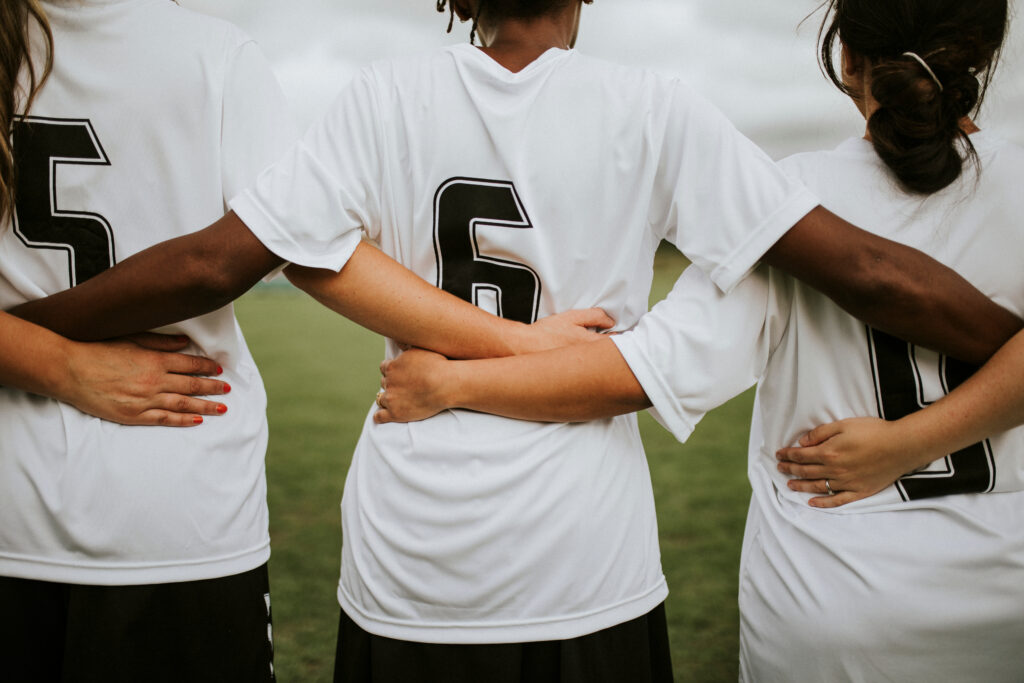
Children in jerseys with arms around each other

On Trans Youth Participation in Sports

If They Ask:

  • “I’ve seen a lot of headlines about trans girls having advantages in school sports. Is that actually true?”

What You Might Say:

  • In school sports, whether that’s volleyball, soccer or basketball, there’s a huge range of body types, builds, and natural ability. Some kids are taller, some are faster, some are more coordinated, some are still finding their confidence. That’s true across all players.
  • That’s always been part of sports. And success is rarely driven by just physical traits—the tallest player on the field isn’t always the one who wins.
  • It’s important to remember: we’re talking about kids. Kids who, at this age, aren’t very different, and who mostly just want the chance to play, grow, and be part of a team.
  • We shouldn’t lose sight of why most kids play sports in the first place. Win or lose, the real benefits, for all of us, come from the life lessons, like perseverance, that stay with us even after we leave the field.

On Fairness & Safety

Every kid deserves the opportunity to learn the lessons sports teach.

If They Ask:

  • “How can it be fair or safe for trans kids to play sports with kids who aren’t trans?”
  • “Why can’t there be a separate category for trans kids to play sports?”

You Can Ask Back:

  • “How would you define fairness in sports for everyone?”
  • “Do you know anyone who has ever raised a fairness or safety concern about a trans athlete playing school sports?

What You Might Say:

  • I know this is something in the news, but I’ve never personally seen an instance where trans kids playing school sports was a problem. There are so few trans athletes to begin with, and the research that’s coming out doesn’t show a competitive advantage for trans girls, it actually suggests the opposite.
  • And more broadly, success in sports depends on so many things: sleep, nutrition, mindset, and some factors we can’t control. Win or lose, the real benefits—for all of us—come from the lessons, like perseverance, that stay with us even after we leave the field.
  • This isn’t just about sports. It’s about kids being fully accepted for who they are at school and beyond. 
  • And when trans girls aren’t able to play on the team that matches their identity, it sends a message that they don’t belong, even when their teammates and coaches see them and know them as who they are. That leaves kids on the sidelines, feeling marginalized and missing out on the crucial life lessons—like teamwork and leadership—we learn from sports and carry through our lives.
  • History shows what’s at stake when we shut people out through bans: what is popular is not always right, and many past exclusions have since been corrected and overturned. When every person feels like they belong, we all grow stronger, even if it feels unfamiliar at first.
  • We’re talking about kids—kids who, at this age, aren’t very different—and whether they have a chance to play school sports. As kids grow, local communities know their students best. Like in New Jersey, where schools figured out a fair solution, and trans students have played sports for 16 years without issue. In Los Angeles, it’s been nearly 12 years, also problem-free.
  • Every kid deserves the opportunity to learn the lessons sports teach, and Title IX has guaranteed fairness in sports for over fifty years without policing children’s differences. Excluding trans kids would change that.

On Being Transgender

No matter what’s being said, trans people have always been here.

If They Ask:

  • “How can someone be transgender?” 
  • “It feels like there are more transgender people now, especially kids. It seems like they’re getting these ideas from social media?”

You Can Ask Back:

  • “What if the world kept telling you that you shouldn’t exist?”
  • “Can you imagine if people didn’t believe something you know is true about yourself?”

What You Might Say:

  • People aren’t defined just by pieces of paper. What’s written on a birth certificate doesn’t decide who I am, who you are, or who a trans person is.
  • There’s a lot of talk about transgender people, and much of it taps into fears people have  of things that are unfamiliar. But those headlines don’t actually reflect the truth about neighbors in our communities or who transgender people are. 
  • No matter what’s being said, trans people have always been here. Trans people are students, teachers, firefighters, police officers, doctors—and so much more. They shape our neighborhoods, our schools, our workplaces, and our lives every single day.
  • Right now, a spotlight is being put on trans kids. But what often gets overlooked is how it feels to be left out at school—to sit alone at lunch, to not be picked for a team, or to not even get the chance to play. Every child deserves to feel like they belong. All this attention, including questioning of who they are, can make trans kids feel unsure of that. 
  • When every kid, and every person, has a fair chance to reach their full potential, we all benefit as a result. Our communities become stronger because everyone has a place to thrive and contribute.

Why This & Why Now?

We must protect rights not just for some of us, but for all of us.

If They Ask:

  • “Why focus on youth sports? LGBTQ+ rights are being attacked, marriage equality is being targeted, and trans people are experiencing real violence, every day.”
  • “Why is this such a big deal? Does this really need to be taken to the Supreme Court?”

You Can Ask Back:

  • “What do you think matters most when we’re trying to protect kids?”
  • “What kinds of issues deserve policymakers’ attention?”
  • “What do youth sports show us about how society sees trans people? What about the LGBTQ+ community?”

What You Might Say:

  • These attacks aren’t just about who gets to play soccer or run track. Politicians are deciding who belongs and who gets let out: trans kids, queer kids, and anyone seen as different.
  • Trans kids face overwhelmingly high rates of bullying. Nearly half have seriously thought about suicide—nine times the rate of other kids. Being left out of school sports is one more important way these young people are being ostracized and having their dignity stripped away.
  • This isn’t just about who gets to play school sports. If politicians are willing to shut kids out of something as formative as playing alongside their friends, there’s no telling what could come next.
  • It’s yet another step toward more discrimination and harm against the entire LGBTQ+ community. That’s why we must protect rights—not just for some of us, but for all of us. Rights that are hard won, fought for over generations.

Want to take this conversation guide on the go or share with family and friends?


Button that reads "Download the Guide"