
Lambda Legal has a long history of fighting discrimination against lesbian, gay, bisexual and transgender (LGBT) people and those living with HIV.
While we have had many victories, our community is still impacted by hostile voter suppression laws across the country. Voter suppression laws and tactics directly impede the ability of various groups of people to register to vote and cast their votes, and to do so with dignity. These tactics disproportionately impact LGB and transgender or gender-nonconforming people, people living with HIV, people of color, individuals with low-incomes, seniors, people who are disabled, people who are formerly incarcerated and individuals in transitional housing and/or in college.
During the 2016 Pride season, Lambda Legal asked 4,813 Pride-goers if they planned on voting in this year’s presidential and local elections. We also asked respondents to tell us their reasons for voting or not voting.
Will You Vote in This Year’s Election?
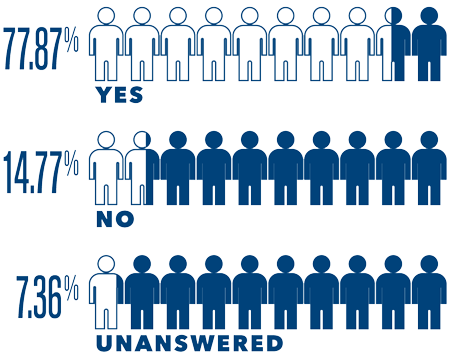
We asked Pride-goers whether they planned on voting in this year’s local and presidential elections. Out of 4,813 total respondents, 3,748 (77.87%) answered “Yes” and 711 (14.77%) answered “No.”
While most voting procedures are governed by one’s state of residence, the Constitution forbids denying the right to vote on the basis of race, sex or age (for those over 18).
Under the Help America Vote Act (HAVA), some voters may be identified as “ineligible” or have their eligibility challenged (because, for example, their gender expression does not match the gender marker on their state identification). These voters should be able to cast a provisional ballot, and the state will inform them after the election whether or not their vote was counted.
If You’re Not Voting, Why Not?
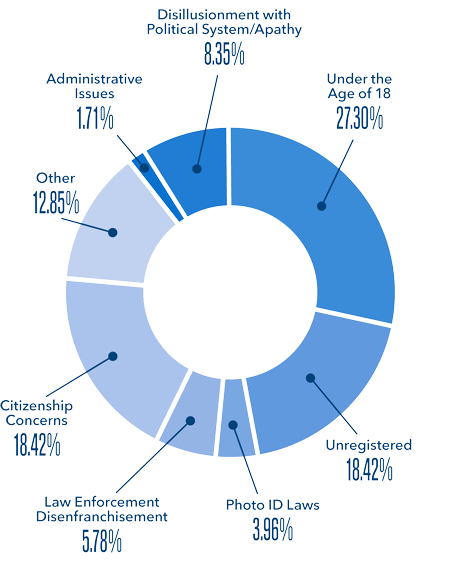
Of the 4,813 people who participated in this survey, 711 (14.77%) reported that they would not be voting in their presidential or local elections this year. This chart shows the percentage of each reason stated by non-voters.
The Voting Rights Act (VRA) bans racial discrimination in voting practices. However, a key provision of it—which required jurisdictions that have restricted voting in the past to get pre-clearance from the federal government before imposing new voting restrictions—was struck down by the Supreme Court in its 2013 Shelby County v. Holder decision.
Lambda Legal believes the government should make it easier—not harder—to vote, and opposes all forms of voter suppression.
If you believe that you have been subject to voter suppression tactics because you’re lesbian, gay, bisexual, transgender or living with HIV, contact Lambda Legal’s Help Desk at lambdalegal.org/help.